
Gutters overflow most often because they are clogged. If they still overflow after a cleaning, the cause is built into the system: the gutter does not slope toward the outlet, the downspouts are too few or too small, the gutters are too small for the roof, or a roof valley sends a stream of water over the edge. A clog you can clear yourself or with a cleaning visit. The built-in causes need a gutter installer, because the fix is to change the hardware. The steps below help you tell which one you have.
The causes, from most to least common
Today's Homeowner (updated March 31, 2025) and Bob Vila (published September 28, 2026) give overlapping lists. Together they cover these causes.
| Cause | How it shows up | Who fixes it |
|---|---|---|
| Clogged gutters or downspouts | Overflow during moderate rain; leaves, grit or nests in the trough | A cleaning, by you or a pro |
| Wrong slope | Water standing in the gutter long after rain stops | An installer re-hangs the run |
| Sagging or loose hangers | Gutter pulled away from the fascia, dips between hangers | A repair, or replacement if widespread |
| Too few or too small downspouts | Overflow only in heavy rain, even though the gutters are clean | An installer adds or upsizes downspouts |
| Gutters mounted too low, too far out, or too small | Water misses the gutter or pours over the front lip | An installer; sometimes new gutters |
| Roof valley or steep section | Overflow at one corner or one spot under a valley | A splash guard or diverter, or a bigger system |
| Failing seams or end caps | Dripping at joints and ends, not over the whole front | A sealing or a section repair |
| Ice dams | Overflow and icicles in winter only | Remove the ice; fix attic heat loss |
| Damaged roof edge | Water running behind or over the gutter | A roofer |
Bob Vila adds that overflow can come from the roof itself: damaged shingles or a worn or badly installed drip edge let water run past the gutter. See drip edge vs gutter apron.
First, find out if it is a clog
Look at when it overflows.
- Overflow in ordinary rain, with debris in the trough: it is a clog. Clean the gutters and downspouts. Today's Homeowner advises cleaning in spring and fall, and Modernize says at least twice a year, or three to four times a year with many nearby trees. Watch the ladder: Today's Homeowner says to use a stable ladder and a spotter, and to hire a pro if you are not comfortable at heights. Our guide to gutter cleaning cost covers the price of a visit.
- Overflow only in a downpour, gutters clean: the system may be too small for the roof. Today's Homeowner says a sudden downpour can exceed the system's capacity.
- Overflow in one place: look at what is above it. A valley, a long roof slope or a downspout that ends there concentrates water.
- Water standing in the gutter a day after rain: a slope problem.
- Overflow in winter only: think ice, below.
Do not use a pressure washer on the gutters. Today's Homeowner warns the force can knock them off their hangers.
Slope and hangers
Bob Vila and Modernize give the same number for a gutter's slope: about 1/4 inch of drop for every 10 feet of run. InterNACHI, the home inspectors' association, gives about 1/16 inch per foot, or 1/4 inch per 5 to 10 feet, and says inspectors do not have to measure it. Instead they look for standing water and compare the gutter's edge with the fascia.
That is a good test for you too. If the gutter edge drifts toward or away from the fascia board along the run, or water stays in a stretch away from the downspout, the slope has shifted. Causes include loose spikes, a rotted fascia or the weight of ice. Re-hanging a run is a job for an installer. Loose fasteners can be a quick repair; widespread sagging may mean replacement, as covered in the signs you need new gutters.
Downspouts: how many and how big
Gutters can only drain as fast as the downspouts take water away. This Old House (updated April 20, 2026) gives these figures:
| Downspout | Roof area it can serve (about) |
|---|---|
| 2 x 3 inch rectangular | 600 square feet |
| 3 x 4 inch rectangular | 1,200 square feet |
| 3 inch round | 706 square feet |
| 4 inch round | 1,255 square feet |
It also gives a rule of thumb of about 1 square inch of downspout opening per 100 square feet of roof, and says gutters 60 feet or longer should have at least two outlets. Its advice is to add downspouts before moving to larger gutters, since larger gutters can change the look of the roofline and may need custom work.
An installer can measure the roof area feeding each run and tell you if your downspouts match it. Adding one is usually cheaper than replacing everything. See downspout cost and extensions.
Gutter size
This Old House says a 5-inch K-style gutter is the usual starting point for homes and can handle roughly 5,520 square feet of drainage area in its table, a 6-inch K-style about 7,960. Half-round gutters handle less: about 2,500 square feet for 5-inch and 3,840 for 6-inch. It adds that steep roofs shed water faster and need more capacity, with a pitch factor that rises from 1.0 for low slopes to 1.3 for the steepest. Large roofs, long runs, several valleys draining to one run, and places with heavy rain are the cases where bigger gutters may be needed.
Do not read those capacity numbers as a design: they are one publisher's table, and a gutter installer sizes the system for the actual roof. Ask which size and shape they propose and why. For types and materials, see seamless vs sectional gutters.
Roof valleys and corners
Family Handyman (updated February 4, 2025) describes a common failure: rain that runs down a roof valley arrives in the gutter with enough speed to leap over the edge. Its fix is a small metal splash guard fastened at the valley, which it prices at about $3 in precut aluminum. Today's Homeowner also lists splash guards and diverters for corners and steep valleys.
Ice and snow
In cold weather, ice at the roof edge can block drainage and the weight of ice can pull gutters down, Today's Homeowner and Bob Vila say. Clogged downspouts and poor attic ventilation or insulation make it worse. Today's Homeowner says to hire a pro to remove ice dams, because winter conditions can cause injuries. This Old House says guards do not prevent them, as our guide to gutter guards notes. Read what causes ice dams for the cause and the fix.
What overflow does if you ignore it
Modernize and Bob Vila list the damage: water streaming down siding, stained or peeling paint, rotted fascia, leaks into walls and basements, mold, soil erosion and foundation problems. Our guide to gutters and foundation damage goes deeper on the last of these.
When to call a pro
Today's Homeowner says to hire a pro for installation errors, which homeowners rarely spot, for large holes or leaks, for ice removal, and when drainage problems continue despite upkeep. Call one if:
- the gutters overflow after you have cleaned them
- you see sagging or a gap between gutter and fascia
- the overflow is always at one corner or valley
- you cannot clean them safely
Get a written estimate that names the fix: re-hang, add downspouts, add a splash guard or replace. If the work is replacement, compare it with what gutter replacement costs, and see questions to ask a gutter installer.
Frequently asked questions
Why do my clean gutters still overflow?
Likely causes are slope, too few or too small downspouts, gutters too small for the roof, or a valley dumping water into one spot. Today's Homeowner lists these as installation problems.
Will gutter guards stop overflow?
They keep debris out, which helps, and Today's Homeowner lists them as a fix. They do not fix a bad slope or too few downspouts, and heavy rain can still shed over some designs. See gutter guards cost.
How often should gutters be cleaned?
Modernize says at least twice a year, and three to four times with many trees nearby.
Can overflowing gutters hurt my foundation?
They can. Water that falls beside the house instead of reaching a downspout can erode soil and flood basements, according to Modernize.
Should I make the gutters bigger or add downspouts?
This Old House suggests adding downspouts first. Larger gutters are a last resort.
Where this information comes from
HomeAnvil does not publish its own gutter data. Everything here comes from the sources below, read on October 13, 2026. This is general information, not advice about your home. Where sources gave different slope figures, we show both.
- Today's Homeowner, preventing overflowing gutters, updated March 31, 2025: causes, fixes, cleaning, when to hire a pro.
- Bob Vila, gutter problems, published September 28, 2026: causes of overflow and slope.
- Modernize, signs of clogged gutters, updated August 12, 2026: signs, cleaning frequency, slope and damage.
- This Old House, sizes of gutters, updated April 20, 2026: gutter and downspout capacities and sizing advice.
- InterNACHI, inspecting gutters and downspouts, read October 13, 2026 (no publication date shown): slope and how inspectors check it.
- Family Handyman, fixing overflow at a roof valley, updated February 4, 2025: valley splash guards and their cost.
Related guides
 How much does gutter replacement cost?New gutters for an average house cost about $2,200 to $5,000, or $4 to $40 a linear foot installed. Costs by material, house size, extras, and repair vs replace.
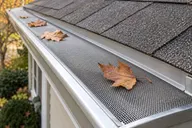 How much do gutter guards cost, and are they worth it?Gutter guards cost about $653 to $2,459 installed, or $6 to $13 a foot; professional systems run $3,000 to $9,000. Types, cleaning costs and payback.
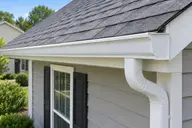 Seamless vs sectional gutters: which should you get?Seamless gutters cost about $6 to $50 a linear foot installed, sectional about $3 to $35. Fewer joints means fewer leaks. Materials, sizes and what to ask.
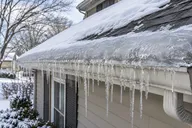 What causes ice dams, and how do you stop them?Ice dams form when attic heat melts roof snow that refreezes at the eaves. How to remove one safely, what not to do, and how to stop them coming back.
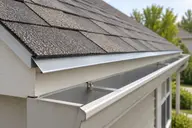 Drip edge vs gutter apron: what's the difference?Drip edge is required at shingle eaves and rakes by the model code; a gutter apron reaches into the gutter. About $1.50 to $3 a foot during a reroof.
 What are the signs you need a new roof?The signs a roof needs replacing, outside and in: age past 20 to 30 years for shingles, bald or curling shingles, repeat leaks, a sagging line. What each means.