
Get everyone out of the rooms under the damage, stay well away from any downed power line, and call 911 if anyone is hurt or a line is down. Then call your insurer. A standard homeowners policy generally covers a tree that falls on your house in a storm, and Triple-I, the insurance industry's information group, says tree removal is generally paid up to about $500. That limit is often far less than the real bill, so read your policy before a crew starts. The tree service takes the tree off. A roofer then covers the opening and repairs the roof. Do not cut or climb anything yourself. This page is general information, not legal, financial or insurance advice, and your policy's own wording decides what is paid.
The first hour: people and utilities
The danger in the first hour is not the roof. It is the electricity, the gas and a structure that may not hold.
Power lines. The Electrical Safety Foundation International (ESFI), a safety nonprofit, says to move away from a downed power line and anything touching it, because the ground up to 35 feet away may be energized. You cannot tell by looking whether a line is live, so assume every one is. ESFI says to shuffle away with small steps, feet together and on the ground, and not to touch anyone who is in contact with a line, because you could become the next victim; call 911. It also says never to move a line, or anything touching it, with a broom or stick, because even wood or cloth can conduct electricity if it is slightly wet. A tree that rests on a line is touching it, so stay away from the tree too.
The house itself. The National Roofing Contractors Association (NRCA) says to shut off electrical power, natural gas and propane if you suspect damage, to avoid fire or explosion. If you see frayed wiring or sparks, or smell something burning, shut off the electrical system at the main circuit breaker and contact the power company. If you smell gas or suspect a leak, turn off the main gas valve, open the windows, leave right away, and tell the gas company, the police or the fire department. NRCA adds not to turn on lights, light matches or do anything that could cause a spark. Only do the breaker or valve steps if you can reach them without going near the damage.
The structure. NRCA calls a storm-damaged roof a potentially unsound structure. Stay out of rooms under the tree until someone qualified has looked at them, and do not go up to check. Our guides to a sagging roof and to rafter and truss repair explain what damaged framing looks like once it has been made safe.
Who does what
A fallen tree on a roof is two jobs, and they go to two different trades.
| Job | Who does it | Why it matters |
|---|---|---|
| Cutting and lifting the tree off | A tree service, sometimes with a crane | Trunks and limbs on a damaged roof can shift; this is specialist work near lines and a weakened structure |
| Covering the hole so rain stays out | A roofer, or a tarp service | NRCA says to cover roof openings temporarily with tarpaulins to limit rain damage |
| Checking the framing and deck | A roofer, and an engineer if the frame is cracked or bent | Damage under the shingles does not show from the ground |
| Permanent repair or replacement | A roofer, after your insurer has seen the damage | Triple-I says to hold off on extensive permanent repairs until the adjuster has assessed the damage |
NRCA says that, other than in extreme situations, you should not attempt roof repairs yourself. A ladder on a storm-damaged roof is the main danger.
Insurance: what pays for the tree and the roof
Triple-I's guide to what a homeowners policy covers says a tree that falls and damages your roof is covered, and that the policy also covers removing the tree. That removal is generally limited to about $500. The same guide says trees and shrubs themselves are not covered for wind damage.
United Policyholders, a nonprofit that helps people with insurance claims, adds detail, and we found it undated:
- Removal is generally paid only when the fallen tree caused damage to your house or another covered structure. A tree that leans but has not fallen is not covered.
- Policies often cap what they pay per tree or shrub, at figures it gives as $500 or $750, and the cap includes debris removal. The cap varies by insurer.
- The total for trees, shrubs and plants is typically 5 percent of your dwelling limit. On a $250,000 dwelling limit that comes to $12,500.
- When a tree falls on the house, many policies pay all the costs under the dwelling coverage, so the tree removal may fall under that coverage instead of the small tree limit. United Policyholders tells you to read the debris removal section of your own policy.
- A tree that falls in your yard and blocks your entrance or exit may have its removal covered. A tree that falls and hits nothing is generally your own expense.
So the same fallen tree can be paid from two different parts of one policy. Ask your insurer which part it is paying from, in writing, before the crew starts. If a tree from a neighbor's yard fell on your house, the same questions go to your own insurer first.
What to do before the tree comes off
The order matters, because the damage is the evidence.
- Photograph and film everything before anything moves. Triple-I's claim steps say to photograph or video the damage and to keep damaged items until the adjuster has visited. Take wide shots of the tree on the roof, close shots of the broken area, the rooms underneath and the part of the tree that stayed standing, with something in the frame for scale.
- Call your insurer. The insurance company must decide, NRCA says, whether the damage is enough to treat the roof as a total loss and how large the roof is. Ask what it needs before removal and whether it wants its own tree service.
- Protect the property from further damage. Triple-I says to take reasonable steps and to keep the receipts, and that payments for temporary repairs count toward your total settlement.
- Get written bids. Triple-I says to get written bids from licensed contractors, with line-item pricing, and to have the adjuster approve the price before work begins. The one exception is a tree that has to come off at once to stop more damage, and then you should tell your insurer why you did not wait.
Tarping and what it costs
HomeAdvisor, a home-services marketplace, puts roof tarping at $150 to $3,300, with a national average of about $450 (updated June 19, 2026). It says emergency or after-hours work often runs 1.5 to 2 times the regular rate, and that a properly installed tarp is effective for up to about 90 days. It lists tree removal as a possible add-on at $200 to $2,000, but a tree on a roof, with a crane or power lines close by, can be a larger job than that average suggests, and we have no neutral source for a price on one. Our guide to emergency roof repair covers tarping, who should do it and the receipts to keep.
If a disaster declaration covers your area, a federal program can also install free temporary sheeting; see our guide to help for a storm-damaged roof. FEMA says that program needs major storm debris cleared first, because its crews clear only minor debris, so a fallen tree is your job to solve first.
Beware of the crew that knocks
Tree crews and roofers arrive fast after a storm, and some are scammers. The FTC says to be wary of anyone who wants cash up front, pushes you to sign right away or asks you to sign over your insurance check, and to confirm a contractor's license and insurance. It also suggests paying by credit card or check and holding the final payment until the work is finished and you are satisfied. Our roofing scams guide has the full list. For how the claim itself runs, read about the roof insurance claim and storm damage to your roof.
Frequently asked questions
Does insurance pay to remove a tree from my roof?
Generally yes, when the tree fell on your house in a storm, but Triple-I says removal is generally limited to about $500, and United Policyholders says some policies pay it under the larger dwelling coverage instead. Your policy decides.
Can I cut the tree off myself?
No. Power lines, a shifting trunk and a damaged structure are all hazards, and NRCA warns that inspecting a storm-damaged roof means climbing a structure that may not be sound.
Who pays if the tree was my neighbor's?
We found no neutral source that settles this, and the answer depends on the facts and on local law. Call your own insurer first, tell it whose tree it was, and read your policy.
Do I have to wait for the adjuster before removing the tree?
Call your insurer first and ask. Triple-I says to document the damage and to hold off on extensive permanent repairs until the adjuster has assessed it. A tree that must come off at once to stop further damage is a different case; keep photographs and receipts.
My tree fell but did not hit the house. Is it covered?
United Policyholders says a tree that falls and hits nothing is generally your own expense, unless it blocks your entrance or exit.
Where this information comes from
HomeAnvil does not publish tree or claim data of its own. Each fact on this page comes from the source named beside it, all read on October 13, 2026:
- ESFI, Downed power line safety, an undated handout: the 35-foot distance, assuming lines are live, shuffling away, not touching a person in contact with a line and not moving a line.
- NRCA, Roof repair after a tornado, undated: shutting off power, gas and propane, frayed wiring and sparks, gas leaks, the insurer's two questions and not attempting repairs.
- NRCA, Roof repair after strong winds, undated: the potentially unsound structure and covering openings with tarpaulins.
- Triple-I, Am I covered?, carrying a 2026 copyright: tree damage, tree removal and the $500 limit.
- Triple-I, Settling insurance claims after a disaster: temporary protection, receipts, written bids and waiting for the adjuster.
- Triple-I, How to file a homeowners claim: reasonable steps and documentation.
- United Policyholders, What's up with trees, shrubs and landscaping insurance coverage, undated: when removal is paid, per-tree caps and the 5 percent figure.
- HomeAdvisor, Cost to tarp a roof, updated June 19, 2026: tarp costs, the emergency premium, tarp life and the tree removal add-on range. HomeAdvisor says its figures come from surveys of its customers.
- FEMA, Frequently asked questions about Operation Blue Roof, last updated January 21, 2025, marked archived: debris cleared before sheeting.
- FTC Consumer Advice, How to avoid scams after weather emergencies and natural disasters, September 2025.
We could not find a neutral national price for emergency tree removal from a roof, so this page gives none. Policy terms vary. We will update this page when these sources change, and the date above will say when.
Related guides
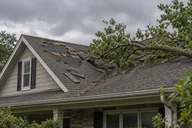 Storm damage to your roof: how to tell and what to doWind damage usually starts at a roof's edges. How to spot lifted, creased and missing shingles and debris damage, and what to do in the first 72 hours.
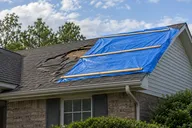 Roofing emergency: what to do and who should tarp itAn open roof or active leak needs a tarp, not a repair. Emergency tarping costs $150 to $3,300, about $450 on average (HomeAdvisor). Safety, receipts, the fix.
 How does a roof insurance claim work after a storm?Insurance usually pays for sudden wind or hail damage, not wear. Wind/hail deductibles often run 1% to 5% of your home's insured value. How a claim works.
 How much does it cost to repair roof rafters or trusses?Repairing a roof rafter costs $300 to $5,000 and a truss $500 to $5,000. Rafters vs trusses, common damage, repair methods and when you need an engineer.
 What does a sagging roof mean, and how serious is it?A sagging roof points to water damage, rot, too much weight or undersized framing. Repairs typically cost $750 to $3,000; when to call a structural engineer.
 How do you spot a roofing scam or a storm chaser?Storm chasers knock unasked, want money up front, offer to cover your deductible or ask you to sign over your claim. How to check a roofer and report one.
- What help is there for a storm-damaged roof?After a declared disaster, insurance pays first. FEMA home repair aid, Operation Blue Roof tarping and SBA disaster loans can fill gaps. What each is and how to apply.
- What is an IBHS FORTIFIED roof?A FORTIFIED Roof is a voluntary storm standard: sealed deck, ring-shank nails, stronger edges and a rated covering. It adds about $1,000 to $3,000 to a re-roof.
- How do you make a roof ready for high winds?Wind-ready roofs start with the deck, the nails and the edges, not the shingle alone. What FEMA and IBHS advise, what to ask a roofer, and what to do before a storm.