
Call your insurer first. Federal help for a storm-damaged roof is built to cover what insurance does not, so FEMA says its aid is not a substitute for insurance and cannot duplicate an insurance settlement. If the storm was part of a declared disaster, three programs may help after that: FEMA home repair aid for losses insurance leaves unpaid, Operation Blue Roof, which puts free temporary sheeting on an eligible roof, and low-interest home disaster loans from the Small Business Administration (SBA). None of them is automatic, and none opens until a declaration covers your county. This page explains what each one is, in what order to use them and how to spot the scams that follow.
This is general information, not legal, financial or insurance advice. Program rules change with each declaration, so we point you to the agency pages instead of copying their lists.
The order that works: insurance, then assistance
FEMA's page on its Individuals and Households Program, last updated July 28, 2026, says the program helps people with uninsured or underinsured needs. It says in so many words that the money is not a substitute for insurance. A FEMA fact sheet for one past declaration adds that if your insurance falls short, you can ask for help with the remaining need by sending in your insurance settlement or denial letter.
So the practical order is:
- Keep everyone safe and cover the roof. See our guide to emergency roof repair for tarping, receipts and who should do the work.
- File your insurance claim. Our guides to storm damage and the roof insurance claim cover photographs, the adjuster visit and what a payout usually looks like.
- Check whether your county is in a declared disaster area, and apply for federal help if it is.
- Keep the paperwork. Whatever your insurer pays or refuses is what FEMA and the SBA will ask to see.
Triple-I, the insurance industry's information group, adds that temporary-repair payments count toward your total settlement, which is one more reason to talk to your insurer before you spend.
Nothing opens until there is a declaration
FEMA's page on how a disaster gets declared, last updated July 29, 2025, explains the sequence. The state or tribe asks for a joint damage assessment, the governor then asks the President for a declaration, and the decision is, in FEMA's words, made solely at the discretion of the President. Whether people and households receive aid depends on several factors, including uninsured home and property losses. FEMA looks at impacts county by county, so a declaration can cover some counties and not others.
You can check yours at DisasterAssistance.gov, which asks you to pick your state and then shows whether your county is in a declared area. That is also where you apply, check an application's status and upload documents. The FEMA helpline is 1-800-621-3362, open seven days a week, 7 a.m. to 10 p.m. in your time zone, according to the site.
What the programs are
| Program | What it gives you | Main conditions | Cost to you |
|---|---|---|---|
| FEMA Individuals and Households Program (home repair) | Money to repair or replace an owner-occupied primary home | Declared disaster in your county; you own and live in the home; insurance or other help does not cover the damage | Financial assistance from FEMA; check the award letter for terms |
| Operation Blue Roof | Temporary sheeting on a damaged roof, installed by contractors for the Army Corps of Engineers | Primary residence or permanently occupied rental; less than 50 percent structural damage; the roof type qualifies | Free |
| SBA home disaster loan | A low-interest loan to repair or replace the primary home and personal property | Declared disaster area; homeowners and renters; loan covers losses not paid by insurance | A loan you repay |
FEMA's pages for each program are in the sources below. Eligibility is set again for every disaster, so read the current notice for yours.
FEMA home repair aid
FEMA's page on Home Repair Assistance, last updated April 15, 2025, describes money to repair your primary home if you own and live in it, a disaster damaged it, and insurance or other help does not cover the damage. The amount is based on the damage FEMA verifies in an inspection. The same page is plain about the limit: the aid is meant to make the home livable, not to restore it to how it was before the storm.
A FEMA fact sheet for one past declaration says home repair is limited to basic work, such as toilets, roofs, utilities, windows and doors. Treat that as an example, not a promise for your declaration. Do not count on this aid to pay for a full replacement with the materials you would choose.
Three other things to expect, all from FEMA:
- Verification. FEMA checks your identity and your ownership and occupancy of the home.
- An inspection. FEMA verifies the damage before it sets an amount.
- A deadline to appeal. The fact sheet we read says an appeal letter must be postmarked within 60 days of the date on the determination letter. Read the date on your own letter.
Operation Blue Roof
Operation Blue Roof is a FEMA program that the U.S. Army Corps of Engineers runs. FEMA's notices about it are written disaster by disaster, so look for an announcement that covers your county. FEMA's frequently asked questions page on the program, last updated January 21, 2025 and marked archived, describes it this way.
- What you get. Blue plastic sheeting, secured with wood strips, to cut further damage until you can arrange permanent repairs. The sheeting is designed to last 30 days, so FEMA suggests lining up the permanent repair within that window.
- What it costs. FEMA says there is no charge to the homeowner or landlord.
- Who is eligible. Primary residences and permanently occupied rentals with less than 50 percent structural damage. Vacation rentals are not eligible, and the home must be habitable once the cover is on. Flat roofs and clay, slate and asbestos tile roofs do not qualify. A federal notice from an earlier disaster said metal roofs and mobile homes were considered case by case; ask about yours.
- What you do first. Major storm debris has to be removed before the crews arrive, because they clear only minor debris. A fallen tree is a good example; our guide to what to do when a tree falls on your roof covers it.
- How you sign up. Complete a Right of Entry form, which lets Corps workers assess and cover the roof, at a collection center in the affected area, or call 1-888-766-3258. A tenant needs the landlord's permission.
The tarp is temporary and it is not a repair. Our guide to emergency roof repair explains why you still need a roofer, and why you should call your insurer too: FEMA's own page tells you to contact your insurance company.
If a contractor sends a bill for a blue roof the government installed, FEMA's alert, released November 8, 2020 and last updated May 2, 2023, says the program is free and that a subcontractor cannot demand payment or file a lien against the home of someone who received one. The notice is archived, so check the current rule with the agency before you pay or refuse anything.
SBA home disaster loans
The SBA lends to homeowners and renters, not only to businesses. Its page on physical damage loans says a homeowner can borrow up to $500,000 to repair or replace a primary residence, and up to $100,000 to replace personal property. Secondary homes and vacation properties are not eligible.
The terms the page lists: the first payment is deferred for 12 months with no interest in that time, the fixed rate will not exceed 4 percent for applicants who cannot get credit elsewhere, and the loan can run up to 30 years with no prepayment penalty. The loan covers losses that insurance does not. The page says insurance proceeds may be deducted from the amount. The money cannot be used to upgrade the home or build an addition unless the local building code requires it. The page gives no date, and loans open only for declared disasters.
A loan is a debt even at a low rate. Our guide to paying for a new roof compares the other options side by side.
Scams that follow the storm
Disaster help attracts people who want your money. Three facts from the agencies:
- FEMA does not certify contractors. FEMA's contractor fraud fact sheet, released September 9, 2025, says it does not license or certify them, so a roofer who says they are "FEMA certified" is not telling the truth. Report it to the FEMA Disaster Fraud Hotline at 866-223-0814.
- FEMA relief is free to apply for. The FTC, in guidance dated September 2025, says anyone who asks for a fee to help you get FEMA relief is trying to defraud you.
- The usual contractor red flags apply. The FTC lists cash up front, pressure to sign at once, a request that you sign over your insurance check, and a blank contract. It suggests paying by credit card or check and holding the final payment until the work is done.
Our roofing scams guide has the full checklist and where to report.
Frequently asked questions
Does FEMA pay for a new roof?
Not as a rule. FEMA says its home repair money is limited and meant to make the home livable, and that it cannot duplicate insurance. If your roof needs full replacement and your insurance pays, FEMA is unlikely to add to it.
Do I have to file with insurance before I apply to FEMA?
FEMA says it cannot duplicate an insurance settlement and asks for your settlement or denial documents when you are underinsured. File your claim first and keep every letter. Then check the application deadline for your declaration on DisasterAssistance.gov; we found no single deadline that applies to every disaster.
Can I get a blue roof if my roof is metal or tile?
FEMA's current frequently asked questions page excludes flat, clay, slate and asbestos tile roofs. It does not mention metal in the eligibility list; an earlier FEMA notice said metal roofs were considered case by case. Ask when you sign the Right of Entry form.
Is a blue roof the same as a repair?
No. It is temporary sheeting meant to last about 30 days. You still need an inspection, an insurance claim and a permanent repair.
Where can I get help if there is no declaration?
Start with your insurer. NRCA, the roofing contractors' association, also lists the American Red Cross, the Insurance Institute for Business and Home Safety and local governments as possible sources of grants or loans in its post-storm guidance. Programs vary by place and by disaster, so call before you rely on one.
Where this information comes from
HomeAnvil does not publish disaster-aid data of its own. Each fact on this page comes from the source named beside it, all read on October 13, 2026. The U.S. Army Corps of Engineers' own Operation Blue Roof pages refused automated reading that day, so the program details come from FEMA's published pages about it.
- FEMA, Individuals and Households Program, last updated July 28, 2026: who the program helps, repair and replacement of owner-occupied homes, and the statement that it is not a substitute for insurance.
- FEMA, What is Home Repair Assistance?, last updated April 15, 2025: the conditions and the limit to a livable home.
- FEMA, Questions and answers about individual assistance, last updated December 19, 2025 and marked archived (it describes one past declaration): basic home repair, no duplication of insurance, settlement or denial documents, and the 60-day appeal.
- FEMA, How a disaster gets declared, last updated July 29, 2025.
- DisasterAssistance.gov, home page: the county lookup, how to apply and the helpline.
- FEMA, Frequently asked questions about Operation Blue Roof, last updated January 21, 2025 and marked archived: eligibility, cost, sheeting life, debris and sign-up.
- FEMA, Alert: homeowners should not pay contractors seeking payment for blue roof installation, November 8, 2020, last updated May 2, 2023 and marked archived.
- FEMA, Beware of post-disaster contractor fraud, September 9, 2025: no certification of contractors and the hotline.
- SBA, Physical damage loans: borrower types, limits, terms and exclusions. The page shows no date.
- FTC Consumer Advice, How to avoid scams after weather emergencies and natural disasters, September 2025.
- NRCA, Roof repair after strong winds: the list of possible grant and loan sources. The file carries no date.
- Triple-I, Settling insurance claims after a disaster: temporary repairs counting toward the settlement.
Programs, limits and deadlines change. We will update this page when these sources do, and the date above will say when.
Related guides
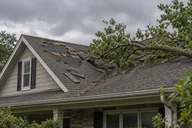 Storm damage to your roof: how to tell and what to doWind damage usually starts at a roof's edges. How to spot lifted, creased and missing shingles and debris damage, and what to do in the first 72 hours.
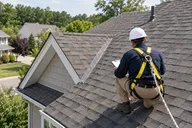 How does a roof insurance claim work after a storm?Insurance usually pays for sudden wind or hail damage, not wear. Wind/hail deductibles often run 1% to 5% of your home's insured value. How a claim works.
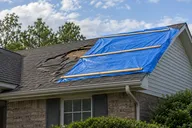 Roofing emergency: what to do and who should tarp itAn open roof or active leak needs a tarp, not a repair. Emergency tarping costs $150 to $3,300, about $450 on average (HomeAdvisor). Safety, receipts, the fix.
 How can you pay for a new roof?Ways to pay for a roof: cash, contractor financing, personal loans, home equity loans and HELOCs, insurance, HUD Title I and FHA 203(k) loans, and what to check.
 How do you spot a roofing scam or a storm chaser?Storm chasers knock unasked, want money up front, offer to cover your deductible or ask you to sign over your claim. How to check a roofer and report one.
- What do you do when a tree falls on your roof?Get people out, stay 35 feet from downed lines, call 911 or your utility, then your insurer. Who removes the tree, the usual $500 removal limit and tarping.
- What is an IBHS FORTIFIED roof?A FORTIFIED Roof is a voluntary storm standard: sealed deck, ring-shank nails, stronger edges and a rated covering. It adds about $1,000 to $3,000 to a re-roof.
- How do you make a roof ready for high winds?Wind-ready roofs start with the deck, the nails and the edges, not the shingle alone. What FEMA and IBHS advise, what to ask a roofer, and what to do before a storm.