
Ridge cap shingles are the pieces that cover the peak of a shingle roof and the sloping lines called hips, where two sides of the roof meet. Fixr, a home-cost publisher, puts a typical ridge cap repair at $200 to $750, in a January 2026 table of repair costs by roof part. That is one national source, and we explain below why we could not show a second. A cap that has blown off or cracked should be fixed soon, because the peak is where the two slopes meet and a gap there is a way in for water.
This page explains what caps are, how a roofer fastens and seals them, why they are often the first part of a shingle roof to fail, and how to read a ridge cap line on an estimate. It is general information, not a recommendation of any product or company.
What ridge cap shingles are
The shingles that cover the flat surfaces of the roof are called field shingles. The ridge is the horizontal peak, and hips are the sloping lines where two roof planes meet at an outside corner. Cap shingles are laid over those lines, bent along their center so they cover both sides, and they seal the seam where the field shingles end.
The Asphalt Roofing Manufacturers Association (ARMA) says in its residential manual that most shingle makers sell at least one hip and ridge product. ARMA names the preferred finish as a shingle made specifically for the job, and says makers can usually supply matching ones, which keep the finished hips and ridges consistent with the field shingles. The other option ARMA describes is to cut caps from the same three-tab shingles used on the roof.
There are two broad shapes. One maker's installation guide, from Malarkey, splits its products into high-profile caps, thicker and meant to go with laminated shingles, and low-profile caps. That guide gives 8 to 12 inches as the width of its caps, and an exposure of 8 1/4 inches for the high-profile type or 5 5/8 inches for the low-profile type. These numbers belong to that one maker's products; other makers' dimensions differ, so your estimate should name the cap product used.
How caps are installed and sealed
Do not climb up to do this yourself. It is a ladder and roof-edge job, and a roofer needs to hit several details. Knowing the details helps you judge the work.
Order. ARMA says to apply the field shingles first, then the hip shingles up to the ridge, then the ridge cap. Ridge caps should overlap the hips where they meet. Malarkey says the same, and tells installers to begin at the bottom of a hip, or at the end of the ridge farthest from the direction of the prevailing wind.
Cover. ARMA says no headlap of the field shingle should show, and that the cap should overlap at least 2 inches on each side of the ridge or hip.
Nails. ARMA's nailing bulletin, revised July 2024, tells installers to size the nails for the whole stack, counting hip and ridge caps among the layers. Nails must go at least 3/4 inch into the deck, or through thinner sheathing. Malarkey's guide uses one nail per side, set so that the next cap hides the heads, and warns against nails that are underdriven or driven too deep. ARMA adds that where two hips meet a ridge, face nailing may be needed, and the nails should be covered with a dab of asphalt roof cement.
Sealing. Most caps carry a factory strip of sealant that bonds with the sun's heat. Malarkey says cold weather, high wind or blowing dust can stop that strip from sealing, and recommends hand-sealing with quarter-size dabs of asphalt roof cement if shingles have not sealed after a reasonable time. It warns that too much cement can blister the cap. ARMA says caps without sealant tabs in high-wind areas should be hand-sealed with 1-inch spots of roof cement under the leading corners, and that where a roof must meet the ASTM D3161 wind-resistance test, caps should get a continuous bead of the maker's sealant.
Cold handling. Malarkey says to warm caps before bending them. Cold caps can crack.
Underneath. The U.S. Department of Energy's Building America Solution Center, quoting a FEMA coastal construction manual, advises lapping the underlayment over the hip and ridge, unless there is a ridge vent, so that water is stopped if the caps blow off.
Why caps fail first
Three things work against caps.
- They are exposed. The peak and hips meet the wind first. InterNACHI, the home inspectors' association, says ridge and hip cap shingles are poorly supported and so more likely to suffer hail damage, and that edges of shingles are more fragile than the middle.
- They depend on sealing. ARMA and Malarkey both call for hand-sealing caps where wind is a concern or the sealant has not bonded. CertainTeed's 2026 warranty says it will supply replacement shingles, but not the labor, when shingles or hip and ridge accessories blow off because the sealant strips did not activate, or because of a cold-weather installation.
- They sit on top of a lot of layers. Caps go over the field shingles, so the nail has more to get through. ARMA says to count them when choosing nail length, and its nailing bulletin lists sealing failures, raised tabs and blow-offs as results of nails that are placed or driven wrongly. Our guide to shingle buckling and nail pops explains those fastener problems.
Wind is a common cause of cap loss, and two storm guides on this site cover how to spot it: see wind-damaged shingles and storm damage to a roof.
What a ridge cap repair costs
| Item | Cost | Source and date |
|---|---|---|
| Ridge capping repair, typical | $200 to $750 | Fixr, updated January 21, 2026 |
| Roofer's labor | $50 to $120 an hour | Fixr, January 21, 2026 |
| Repairing or replacing a roof vent | $75 to $250 | Fixr, January 21, 2026 |
| Damaged or missing shingles, for comparison | $150 to $700 | Fixr, January 21, 2026 |
| Installing a ridge vent, all in | $300 to $650, average $500 | HomeAdvisor, updated June 19, 2026 |
Fixr's page says ridge cap repair costs fall "somewhere in the middle" of the repair costs it lists. It does not give a price per foot. HomeAdvisor's page covers ridge vents, not caps, so its figure is a separate job: a ridge vent is an exhaust opening along the peak, and our roof ventilation guide explains when you need one.
We looked for a second published cost guide for ridge cap repair and could not use one. Several pages block automated reading. Two pages we could read, from This Old House and from a 2023 Bob Vila guide, price ridge capping at the same $250 to $750 band, but they describe tile or mortar work, so we do not treat them as figures for shingle caps. Treat the Fixr range as a rough planning figure, not a quote, and get a written estimate for your roof.
What moves the price, according to the sources and basic arithmetic:
- Length of ridge and hips. A cap is installed along a line, so more feet mean more labor and materials. This is our own reasoning; Fixr gives no per-foot rate.
- Replace a few or the whole line. A few missing caps are a small job. If the sealant has failed along the whole ridge, a roofer may replace the entire course.
- Roof pitch and height. Steep or tall roofs take more time. The cost sources do not give a figure for this.
- Ridge vent. If a vent runs along the peak, the repair has to work with it. ARMA says to follow the vent maker's instructions for the caps over it.
- Minimum charge. Fixr does not state a minimum service call. Ask the roofer before booking. Our guide to shingle repair cost explains why a small job still carries a visit charge.
Repair or replace the caps?
A patch makes sense when the rest of the cap course is sound and sealed. If caps are cracked across the whole ridge, lifted along its length, or the nails show through, a patch may not hold. ARMA says that on a re-roof where old roofing is left in place, the old hip and ridge shingles should be removed, to get a level surface and better fastener anchorage. That is one reason a roofer who replaces your roof should include new caps on the estimate rather than leaving the old ones.
Roofs near the end of their life are different. If the field shingles are worn out, new caps will not save them; our guide on whether to repair or replace a roof covers that choice, and roof repair cost shows what other repairs run.
How to read the ridge cap line on an estimate
On a replacement estimate, hip and ridge caps are usually a separate line. Look for:
- The product by name, and whether it matches the shingle. Some warranties tie wind or algae coverage to the maker's own caps. Owens Corning's 2026 standard warranty lists its hip and ridge shingles among the qualifying components, and says algae coverage of 25 years needs one of its ridge products. CertainTeed's 2026 warranty ties its 130 and 160 mph wind upgrade to its matching cap shingles and starter shingles. Our guide to roofing warranties covers these conditions.
- How many feet of ridge and hip are being capped.
- Whether old caps are removed. ARMA says to remove them on a re-cover.
- Whether hand-sealing is included where the weather is cold or the job is wind-exposed.
- Ventilation. If the roof has a ridge vent, ask who handles the cap work over it.
Frequently asked questions
Are ridge cap shingles the same as regular shingles?
Not usually. ARMA says the preferred cap is a shingle made for the job, and makers sell matching caps. ARMA also describes cutting caps from three-tab shingles as an option.
How much does it cost to replace ridge cap shingles?
Fixr's January 2026 figure for a ridge cap repair is $200 to $750. We could not find a second usable published figure for shingle caps, so use it as a rough guide.
Why did my ridge caps blow off?
Wind is the usual cause, helped by sealant that never bonded, short or poorly driven nails, or caps that were installed in cold weather. Maker documents say cold weather, wind or dust can stop the sealant from activating.
Is a missing ridge cap an emergency?
Caps do blow off, which is why the Building America guidance suggests lapping underlayment over the ridge. Have a roofer look soon, and see emergency roof repair if water is already coming in.
Does a warranty cover blown-off caps?
Possibly under a wind warranty, with limits. CertainTeed's 2026 warranty replaces blown-off hip and ridge accessories at no charge in some cases, but without labor, and neither maker's warranty we read covers winds above the rated speed.
Where this information comes from
HomeAnvil does not yet publish price data of its own. All sources below were read on October 13, 2026. We cite maker documents because they are the source of the details, and we do not recommend any product or company.
- Fixr, roof repair cost, updated January 21, 2026: ridge capping at $200 to $750, vent and shingle repair costs, and labor per hour.
- HomeAdvisor, roof ridge vent installation cost, updated June 19, 2026: the cost of a ridge vent, and its labor.
- ARMA, Asphalt roofing residential manual, 2014 edition: hip and ridge application, overlap, face nailing, hand-sealing and removing old caps on a re-cover.
- ARMA, Nail application of asphalt shingles, revised July 2024, read from a shingle maker's copy: nail length and driving.
- Malarkey Roofing Products, Hip and ridge shingles installation instructions: cap shapes, sealing, fastening, cold handling and the start point against the wind.
- Building America Solution Center, U.S. Department of Energy, lapping underlayment over hip and ridge, quoting FEMA P-55, Coastal Construction Manual, fourth edition: underlayment over the ridge.
- InterNACHI, Mastering roof inspections: hail damage, part 6, no date shown: ridge and hip caps as poorly supported, and fragile edges.
- CertainTeed, Asphalt shingle limited warranty, 2026: wind upgrade conditions and blow-off terms for hip and ridge accessories.
- Owens Corning, Standard limited lifetime warranty on roofing shingles and components, for shingles purchased after January 1, 2026: hip and ridge shingles as qualifying components and the algae-coverage condition.
- This Old House, cost of roof repair, updated March 5, 2026, and Bob Vila, roof repair cost, updated June 9, 2023: read, and set aside because they price tile ridge capping.
We will update this page when these sources change, and the date above will say when.
Related guides
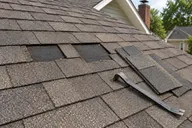 How much does it cost to replace missing shingles?Replacing a few missing or damaged shingles usually costs $150 to $700. A bundle costs $25 to $40. When a patch becomes a section or a new roof.
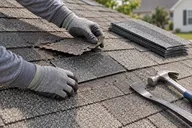 How much does a roof repair cost?Most roof repairs cost $395 to $1,967, about $1,173 on average. Prices by problem: shingles, flashing, leaks, decking, vents, fascia and sagging.
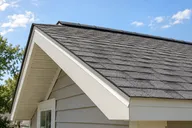 How much attic ventilation does a roof need?Code calls for 1 square foot of net free vent area per 150 square feet of attic, split between intake and exhaust. How vents work, warning signs and costs.
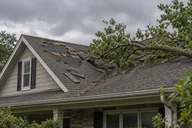 Storm damage to your roof: how to tell and what to doWind damage usually starts at a roof's edges. How to spot lifted, creased and missing shingles and debris damage, and what to do in the first 72 hours.
 Hip vs gable roof: cost, wind resistance and upkeepHip roofs cost more to build but see up to 50% lower peak wind pressures than gables in wind-tunnel tests. Cost, wind, insurance, attic and upkeep compared.
- What do wind-damaged shingles look like and cost to fix?Wind-damaged shingles are lifted, creased or missing. A few usually cost $150 to $700 to fix; here is how to spot the damage and when it is an insurance claim.
- What is an asphalt shingle roof, and is it right for you?Asphalt shingles are the most common home roof. 3-tab starts near $1.50 a square foot, architectural near $3.50. Life, wind, hail and warranty compared.