
Home insurance usually pays for a roof replacement when a covered event, such as wind, hail or a falling tree, damages the roof badly enough that repair will not do. It does not pay to replace a roof that has simply worn out. Even when the claim is covered, the amount depends on three things in your policy: whether it pays replacement cost or actual cash value, your deductible, and any special limits on roofs. This page explains what is covered and what is not. It is general information, not legal or insurance advice, and your own policy decides every question here.
What counts as a covered cause
The Insurance Information Institute (Triple-I), the insurance industry's information group, says homeowners policies typically cover roof damage that results from a covered peril, such as wind, hail or falling trees. The NAIC, the association of state insurance regulators, makes the same point from the other side: a homeowners policy insures against damage from perils like fire, wind and hail, and it is not a maintenance contract.
Many standard policies are written as "open perils" for the house itself. The industry's sample HO-3 form, which Triple-I publishes, says the insurer insures against risk of direct physical loss to the dwelling and then lists what it does not insure. So the question is often not "is hail on the list?" but "is this loss on the exclusion list?" Your policy may be written differently, so read the section on your dwelling.
| Event | Usually covered? |
|---|---|
| Wind lifts or tears off shingles | Usually yes, as a covered peril |
| Hail breaks or bruises shingles | Usually yes, subject to any cosmetic exclusion (see below) |
| A tree or limb falls on the roof | Usually yes |
| Shingles curl, crack or lose granules with age | No, wear and tear |
| A leak from a roof nobody maintained | No, maintenance |
| Damage from a poor earlier repair or install | No, defective workmanship, though a covered loss that follows may be paid |
What insurance does not pay for
Triple-I says a standard policy will not pay for routine wear and tear. The sample HO-3 form lists the same exclusion in plain terms: wear and tear, marring and deterioration, along with latent defect, rust or other corrosion, and mold, fungus or wet rot in most cases. It also excludes faulty or defective workmanship, repair, materials and maintenance. A separate exclusion covers neglect, which the form defines as failing to use reasonable means to save and preserve property at and after the time of a loss.
The NAIC puts the owner's side of this simply. You are responsible for upkeep, such as repairing a roof when it begins to leak. If your roof is at the end of its life, that is a replacement you pay for, and our guide to how long a roof lasts and the list of signs you need a new roof help you judge where yours stands.
The form's exclusions are worded as a list, and some of them carry exceptions. The sample form pays for ensuing loss that is not otherwise excluded, so a covered result of an excluded cause may still be paid. Read the exact words with your adjuster; do not assume.
A sudden leak versus a slow one
Many homeowners ask if insurance covers a roof leak. The honest answer is that it depends on why the roof leaks and what the water damaged.
The sample HO-3 form treats the house and your belongings differently. For belongings inside, its wind and hail peril pays for rain, snow or sleet damage only when the direct force of wind or hail first damages the building and makes an opening in a roof or wall, and the water comes in through that opening. A tree limb that punches a hole and lets rain in fits. A roof that has worn thin and weeps in heavy rain does not fit, because the cause is wear.
For the house itself, the form's wear and tear, deterioration, mold and maintenance exclusions do the work. A slow, small, old leak invites those questions; a sudden one after a storm usually does not. If you spot a leak, stop the water first. Triple-I's claim guide says to take reasonable steps to prevent further harm and keep receipts, because those costs may be reimbursed. Our roof leak repair guide covers finding and fixing the leak itself.
Actual cash value or replacement cost
Whether a covered roof claim pays for a new roof or only part of one depends on how your policy settles losses.
- Replacement cost pays to repair or replace with similar material, without subtracting depreciation. Triple-I defines depreciation as the decrease in value from age, obsolescence, wear and tear and other factors.
- Actual cash value pays the depreciated amount.
The NAIC gives a worked example in an article on rebuilding after a storm. Two homes each have $15,000 of roof damage and a $1,000 deductible. The home with replacement cost coverage receives $14,000. The home with actual cash value coverage has $10,000 taken off for depreciation and receives $4,000. Triple-I adds that with a 15-year-old roof damaged by a tree, replacement cost would pay for the roof in full, while actual cash value would pay a smaller percentage.
An old roof can also change the type of coverage you have. Triple-I says most insurers require an inspection when a roof is over 20 years old, and some decline to insure such roofs. Our guide to roof age and home insurance goes into depreciation and inspections in detail.
Roof payment schedules and cosmetic exclusions
Two add-ons catch homeowners by surprise because they apply to roofs in particular.
Roof payment schedules. A trade publication for insurance professionals, Rough Notes, explains that a roof payment schedule sets a percentage of repair or replacement cost by the roof's age and material. The older the roof, the smaller the percentage. A related endorsement, ISO form HO 04 93, switches wind and hail roof losses to actual cash value, and that article notes it applies even after you replace the roof, so it stays on the policy until removed. Ask your agent whether either appears on your declarations page.
Cosmetic damage exclusions. An insurer can add a cosmetic damage exclusion for roof surfacing. A sample endorsement from the American Association of Insurance Services, filed with a state insurance regulator in 2023, defines cosmetic damage as marring, scratching, denting, pitting, discoloration or another condition that changes appearance but does not stop the roof keeping weather out as well as before. It then says the insurer does not pay for wind or hail damage to roof surfacing when that damage consists solely of cosmetic damage. For metal roofs, where hail often dents without leaking, this can matter a lot. Our hail damage guide covers what functional hail damage looks like.
Your deductible and wind or hail limits
Triple-I says most insurers offer a minimum deductible of $500 or $1,000 and that the deductible applies each time you file a claim. Wind/hail deductibles are most commonly percentages, typically 1% to 5% of the home's insured value. The NAIC notes that some policies have special deductibles that apply to parts of the home like the roof. It also says some policies exclude wind and hail, which is common in coastal areas, and then a separate policy may be needed.
On a $300,000 home with a 2% wind/hail deductible, you pay the first $6,000 of the claim (our arithmetic on Triple-I's percentage method). Our roof insurance claim guide has a table, and file a roof claim or pay yourself shows when the numbers say not to file.
What to do next
- Find the roof and wind/hail parts of your policy: deductible, settlement basis, any schedule or cosmetic exclusion.
- Photograph the damage from the ground. Do not climb up; the roofing trade association NRCA says to inspect a roof system only from ground level.
- Call your insurer before you sign with a contractor. The steps are in how a roof insurance claim works.
- If the roof is old and no storm hit it, plan for the cost yourself. Roof financing lists the options.
Frequently asked questions
Will insurance pay for a new roof if mine is 20 years old?
Only if a covered event damaged it. Age alone is wear and tear, which is excluded. If a covered storm damages an older roof, you may be paid at actual cash value, which subtracts depreciation.
Does homeowners insurance cover roof leaks?
It can, when the leak follows sudden covered damage, such as a limb that opens the roof. A leak from a worn or neglected roof is generally not covered.
Will insurance replace the whole roof or just the damaged part?
It depends on the extent of the damage and on your policy's wording. Some policies pay to repair only the damaged area. Our roof insurance claim guide covers the matching problem when new shingles do not match old ones.
Are hail dents on a metal roof covered?
Not always. A cosmetic damage exclusion can remove coverage for dents that do not affect how the roof sheds water. Check your policy for the exclusion.
What if my claim is denied?
You can ask for the reason in writing and have it reviewed. See what to do if your roof insurance claim is denied.
Where this information comes from
HomeAnvil does not publish claim data of its own. Each fact comes from the source named beside it, read on October 13, 2026.
- Triple-I (Insurance Information Institute), How your roof influences your home and business insurance: covered perils, actual cash value, the 20-year inspection.
- Triple-I, What is covered by standard homeowners insurance?: wear and tear is not paid.
- Triple-I, Homeowners 3 special form, sample (ISO HO 00 03 10 00): open-perils wording, wear and tear, defective workmanship, maintenance, mold, neglect and the rain-entry condition. This is a sample form from 2000; current policies vary.
- Triple-I, How is the settlement amount determined?: replacement cost, actual cash value, depreciation and the 15-year-old roof example.
- Triple-I, How to file a homeowners claim: preventing further damage and keeping receipts.
- Triple-I, Understanding your insurance deductibles: per-claim deductibles and the 1% to 5% wind/hail range.
- NAIC, A Consumer's Guide to Home Insurance, 2022: the policy is not a maintenance contract, roof upkeep, replacement cost and actual cash value, wind and hail exclusions in some policies.
- NAIC, Rebuilding after a storm: replacement cost and actual cash value for your roof, July 22, 2021, modified March 26, 2025: the $15,000 example and roof deductibles.
- American Association of Insurance Services, sample cosmetic damage exclusion endorsement (form HO 2002 07 13), as filed with a state insurance regulator on November 20, 2023: the definition of cosmetic damage and the roof surfacing exclusion. One insurer's filed sample, not every policy.
- Rough Notes, Homeowners roof surfacing coverage considerations, January 30, 2026: payment schedules and the HO 04 93 endorsement. A trade publication.
- NRCA, guidance on inspecting storm-damaged roofs, July 27, 2022: inspect only from ground level.
- The $6,000 deductible example is our own arithmetic.
Policy terms and the rules that apply to them differ by insurer and by state. When this page and your policy differ, your policy decides, and your state's department of insurance can explain your rights.
Related guides
 How does a roof insurance claim work after a storm?Insurance usually pays for sudden wind or hail damage, not wear. Wind/hail deductibles often run 1% to 5% of your home's insured value. How a claim works.
 How does your roof's age affect your homeowners insurance?Many insurers inspect or decline roofs over 20 years old, and older roofs are often paid at depreciated value. What to check in your policy and at renewal.
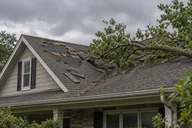 Storm damage to your roof: how to tell and what to doWind damage usually starts at a roof's edges. How to spot lifted, creased and missing shingles and debris damage, and what to do in the first 72 hours.
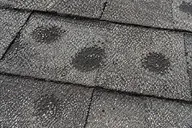 How do you know if hail damaged your roof?Quarter-size (1 inch) hail can start to damage older 3-tab shingles, laminated ones at 1.25 inches. How to spot real damage and when to call your insurer.
 How to find and fix a roof leak, and what it costsA roof leak repair typically costs $350 to $1,500, about $800 on average. How to trace a leak from the attic, what to do first and what each fix costs.
 How can you pay for a new roof?Ways to pay for a roof: cash, contractor financing, personal loans, home equity loans and HELOCs, insurance, HUD Title I and FHA 203(k) loans, and what to check.
- Should you file a roof claim or pay yourself?If the repair costs about your deductible or less, paying yourself is usually simpler. How to compare the estimate with your deductible, and what filing leaves on record.
- What is a roof claim supplement?A supplement asks your insurer for more money after the first estimate. How recoverable depreciation, hidden damage and the mortgage company on the check work.
- What if your roof insurance claim is denied?A denial is not always final. Ask for it in writing, check the policy clause it cites, use appraisal for amount disputes, and complain to your state's insurance department.