
Most asphalt shingles are either about 12 by 36 inches (the older "imperial" or "English" size) or about 13¼ by 39⅜ inches (the "metric" size), with 5 to 5⅝ inches of each shingle showing on the roof. A square of common 3-tab and laminated shingles weighs roughly 190 to 225 pounds, according to the data sheets we read. Heavy, thick luxury shingles run 350 to 465 pounds per square. Which size and weight your roof has decides whether a repair will line up, how much a second layer adds, and how heavy the old and new material is to haul.
The numbers on the data sheet
Shingle makers publish a short list of figures for each line. Here are the ones we found on the makers' own sheets, read on October 13, 2026.
| Shingle (as published by the maker) | Overall size | Exposure | Weight per square | Shingles per square |
|---|---|---|---|---|
| CertainTeed XT 25, 3-tab | 12 x 36 in | 5 in | about 190 to 203 lb | 80 |
| Owens Corning Supreme, 3-tab, imperial | 12 x 36 in | 5 in | not given | 80 |
| Owens Corning Supreme, 3-tab, metric | 13¼ x 39⅜ in | 5⅝ in | not given | 65 |
| IKO Marathon Plus AR, 3-tab | 13¼ x 39⅜ in (336 x 1000 mm) | 5⅝ in (143 mm) | not given | 65 |
| CertainTeed Landmark, laminated | 13¼ x 38¾ in | 5⅝ in | 211 to 225 lb | 65 |
| Owens Corning TruDefinition Duration, laminated | 13¼ x 39⅜ in | 5⅝ in | not given | 64 |
| Owens Corning Berkshire, large-format premium | 18¾ x 38 in | 8⅜ in | 360 lb | 45 |
| Owens Corning Woodcrest, thick luxury | 14¼ x 40 in | 4 in | 350 lb | 90 (6 bundles of 15) |
| Owens Corning Woodmoor, thick luxury | 14¼ x 40 in | 4 in | 465 lb | 90 (6 bundles of 15) |
Sources are listed at the end. Owens Corning's weights are what it calls "nominal weight" in an April 2019 product guide; CertainTeed's are "approximate" weights per 100 square feet, and its Landmark sheet says the weight depends on where the shingles were made. Makers retire and rename lines, so treat the table as an example of the spread, not a catalog. The weight and size of your own shingle is on its data sheet or the wrapper.
Two sizes: imperial and metric
Roofing in the United States has two common shingle sizes. Owens Corning's guide shows both for one 3-tab line: the imperial size is 12 by 36 inches with 5 inches of exposure and 80 shingles per square, the metric size is 13¼ by 39⅜ inches with 5⅝ inches of exposure and 65 per square. CertainTeed says its XT 25 comes in the English size only. Most laminated shingles we read are the larger metric size.
The metric size is about 1,000 millimeters long by 336 millimeters tall, which is how IKO lists its 3-tab shingle. The inch figures are the same dimensions converted, so "39⅜ inches" and "1,000 millimeters" describe one shingle. Makers differ on which side they call the length, so read the sheet: IKO's lists length first and width second, and Owens Corning's gives the height first. Size and exposure are the first two items to check on a data sheet.
What exposure is, and why it matters
A shingle does not show its whole face. The next course overlaps it, and what is left uncovered is the exposure. In the sheets above it ranges from 4 inches on a thick luxury shingle to 8⅜ inches on a large-format one.
Exposure is the link between the numbers. Our check, which is our arithmetic, is that coverage per square equals the number of shingles per square times the shingle's length times its exposure. For CertainTeed's Landmark that is 65 × 38¾ × 5⅝ ÷ 144, or about 98.4 square feet, the coverage its sheet gives. For the old 3-tab size it is 80 × 36 × 5 ÷ 144, or exactly 100. That works for every line in the table, and it is why the shingle count and the bundle count on an estimate must fit together. Our guide on how many bundles are in a square shows how to read that quantity.
Why size matters for repairs and for matching
- Courses have to line up. A roof is laid in rows, and each row is offset from the one below by its exposure. A replacement shingle with 5 inches of exposure next to one with 5⅝ inches will sit at a different height from its neighbors, so a metric repair on an imperial roof is a patch, not a match. Our architectural vs 3-tab shingles guide covers the 3-tab versus laminated look.
- Discontinued shingles. If your line is no longer made, a roofer may look for the closest size, thickness and color. ARMA says color variation is most noticeable on dark shingles, as we note in shingle repair cost. Keep a leftover bundle from the original job if you have one.
- Estimates. An estimate that names the shingle line, size and exposure can be checked against the sheet. One that says only "30-year shingles" cannot.
Weight per square, per bundle and per roof
Weight is quoted per square, which is 100 square feet of roof. These are our arithmetic from the sheets above, for a roof of about 19 squares, the example in roof replacement cost:
| Shingle weight per square | Per bundle on a 3-bundle line | New shingles on a 19-square roof |
|---|---|---|
| 190 lb (3-tab low end) | about 63 lb | about 3,600 lb |
| 225 lb (laminated high end) | about 75 lb | about 4,300 lb |
| 360 lb (large-format premium) | not 3 bundles; 5 per square | about 6,800 lb |
| 465 lb (thick luxury) | not 3 bundles; 6 per square | about 8,800 lb |
Weight per bundle is the weight per square divided by the bundle count, so it only applies to 3-bundle lines. On the same roof, a heavy premium shingle puts well over one and a half times the load of a common one, by our arithmetic.
What the weight means for layers and loading
- A second layer. A second layer of shingles roughly doubles what the roof carries. Our guide on roofing over existing shingles covers the rules and risks, including the extra weight on the structure.
- Heavier shingles. The extra weight of luxury shingles is a reason to ask a roofer or an engineer whether the framing and decking are sound before the job. Our roof decking and underlayment guide covers the deck.
- Tear-off. Old shingles are heavy when they come off, and the load depends on how many layers there are and how much they have weathered. We could not find a sourced figure, so ask your roofer how the old material is removed and taken away.
Frequently asked questions
What size is a standard roofing shingle?
There is no single standard. The older 3-tab size is 12 by 36 inches with a 5-inch exposure. The common metric size is about 13¼ by 39⅜ inches with 5⅝ inches showing.
How much does a square of shingles weigh?
About 190 to 203 pounds for CertainTeed's XT 25 3-tab and 211 to 225 pounds for its Landmark laminated shingle, per the data sheets. Owens Corning's premium lines give 350 to 465 pounds.
How many shingles are in a bundle?
It varies by line. On Owens Corning's sheets a 3-bundle line holds 20 or 22 shingles, a 4-bundle line 16, a 5-bundle large-format line 9 and a 6-bundle luxury line 15.
Can I mix shingle sizes on one roof?
A repair can use a different size, but the courses will not line up and the rows will look uneven. Ask your roofer to try to match the size, exposure and color first.
Is a heavier shingle better?
Weight is not a quality rating. It follows from the shingle's construction and size. For performance, read the warranty and the standards on the sheet, such as the wind and fire classes.
Where this information comes from
HomeAnvil does not yet publish price data of its own. The size, exposure and weight figures come from the makers' published sheets, read on October 13, 2026. The check that coverage equals shingles times length times exposure, the weight per bundle and the weights on a 19-square roof are our arithmetic. This is general information, not legal, tax, financial or insurance advice.
- CertainTeed, XT 25 shingles technical data sheet: size, exposure, shingles and weight per square; English size only.
- CertainTeed, Landmark shingles technical data sheet, copyright August 2024: size, exposure, shingles, weight by plant and coverage per square.
- Owens Corning, Roofing full product line guide, April 2019: Supreme imperial and metric, Berkshire, Woodcrest and Woodmoor sizes, exposure and nominal weights.
- Owens Corning, specification guide: fiberglass-based asphalt shingles and accessories: Duration size, exposure and shingles per square.
- IKO, Marathon Plus AR summary brochure: size in inches and millimeters, exposure and shingles per square.
- HomeAnvil guides on shingle repair cost and roof replacement cost, which cite ARMA and HomeAdvisor.
Related guides
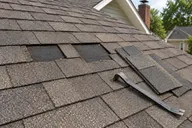 How much does it cost to replace missing shingles?Replacing a few missing or damaged shingles usually costs $150 to $700. A bundle costs $25 to $40. When a patch becomes a section or a new roof.
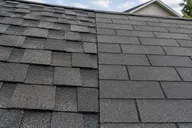 Are architectural shingles worth it over 3-tab shingles?Architectural shingles start near $3.50 a square foot against $1.50 for 3-tab, last about 30 years instead of 20, and carry longer warranties.
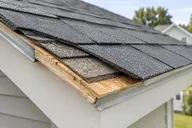 Can you put new shingles over old ones?Often yes, once: the building code bars a layover on a roof with two or more layers. What a roof-over saves, what it adds in weight, and what it hides.
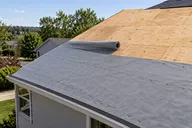 Roof decking and underlayment: what they are and costReplacing roof decking costs $2 to $5 a square foot; a sheet of plywood or OSB runs $9 to $64. How the deck, underlayment and ice barrier work.
 How much does an architectural shingle roof cost?An architectural shingle roof costs about $4 to $6 a square foot installed per HomeAdvisor, and up to $15 for designer lines per Fixr. Totals by roof size.
- How many bundles of shingles are in a square?Most shingle lines take 3 bundles to cover a 100 square foot square, but some take 4, 5 or 6. How to read the bundle count and waste allowance on your estimate.
- What is an asphalt shingle roof, and is it right for you?Asphalt shingles are the most common home roof. 3-tab starts near $1.50 a square foot, architectural near $3.50. Life, wind, hail and warranty compared.